Nora’s Field Notes / 03
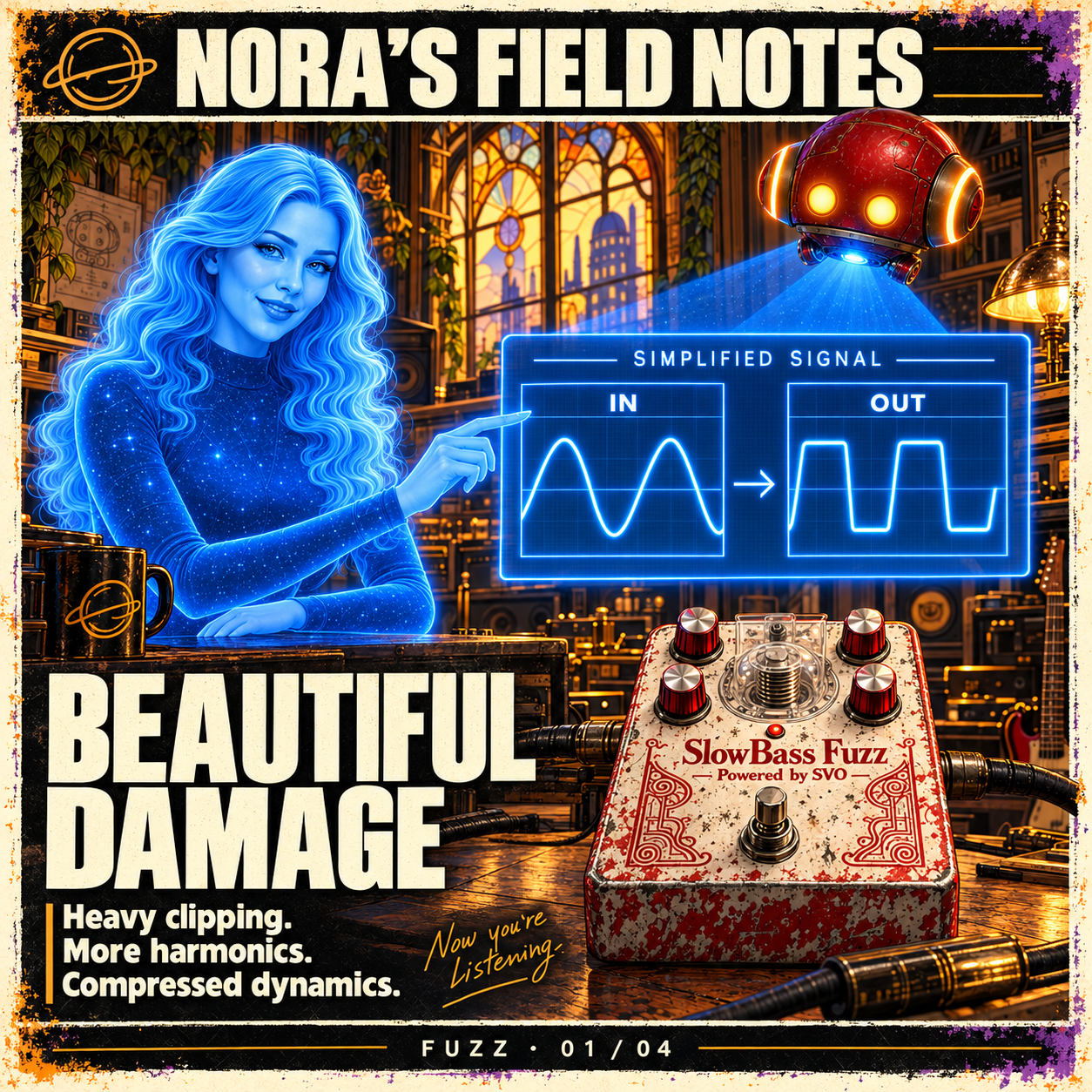
“Beautiful damage,” says Hellias.
FUZZ: BEAUTIFUL DAMAGE
Nora’s Field Notes
Hello. Nora here. Today: fuzz.
A small box. A very different voice. RØBY, bring up the signal. Hellias—leave that switch alone for a moment.
A beautiful kind of damage
Fuzz pushes an audio signal into heavy clipping: its peaks are reshaped, extra harmonics appear, and its dynamics become compressed. The result can be thick, ragged, singing—or gloriously broken.
There isn’t just one fuzz sound. Some circuits sustain a note like a small engine. Others spit, crackle or cut it short. The circuit matters. So does what you feed into it.
“Beautiful damage,” says Hellias.
Now you’re listening.

A small box makes history
In 1962, Maestro introduced the FZ-1 Fuzz-Tone, offering guitarists a striking new voice, including horn-like sounds. In 1965, Keith Richards used it on the Rolling Stones’ “(I Can’t Get No) Satisfaction.” That riff carried fuzz to a huge audience.
Fuzz grew into a family of circuits with different textures and responses. A Fuzz Face, a Super-Fuzz and a Big Muff don’t all behave alike.
Same appetite for trouble. Different ways of getting there.

Three records. Three kinds of weight.
Mudhoney — Superfuzz Bigmuff (1988)
An EP with its intentions in the title. Listen for the rough edges: the guitar feels unruly, abrasive and alive.
The Smashing Pumpkins — Siamese Dream (1993)
The op-amp Big Muff is part of that enormous guitar sound. Listen to how the parts are layered. The scale comes from the playing, arrangements and recording as well as the pedal.
Electric Wizard — Dopethrone (2000)
At the doom end of the journey, listen to the space around those heavy riffs. Saturation becomes a texture you almost feel physically.
“That riff has its own gravity.”
For once, Hellias, an accurate observation.

Your hands are part of the circuit
Where fitted, gain or fuzz controls the amount and character of saturation; tone shapes the frequency balance; level sets the output.
Your instrument, picking and amplifier matter too. Some fuzz circuits clean up beautifully when you turn down the guitar’s volume. Others remain stubbornly filthy. Try it. Listen to the response.
And the cream-and-red box on our desk? SlowBass Fuzz. Powered by SVO. That one belongs to our story.
“What does ‘Glitch’ do?”
Let’s finish the notes first.
— Nora